Ford — Reimagining Warranty Claims
Modernizing a legacy warranty system through co-creation, data-driven insights, and rapid prototyping.
Overview
As UX Lead, I facilitated a design sprint with Ford focused on reimagining the Online Warranty System (OWS), a core platform for managing claims across dealerships, internal reviewers, and regional teams. The objective was to uncover ways to increase automation, reduce manual review, and create a smarter, more intuitive experience for warranty administrators.
Challenge
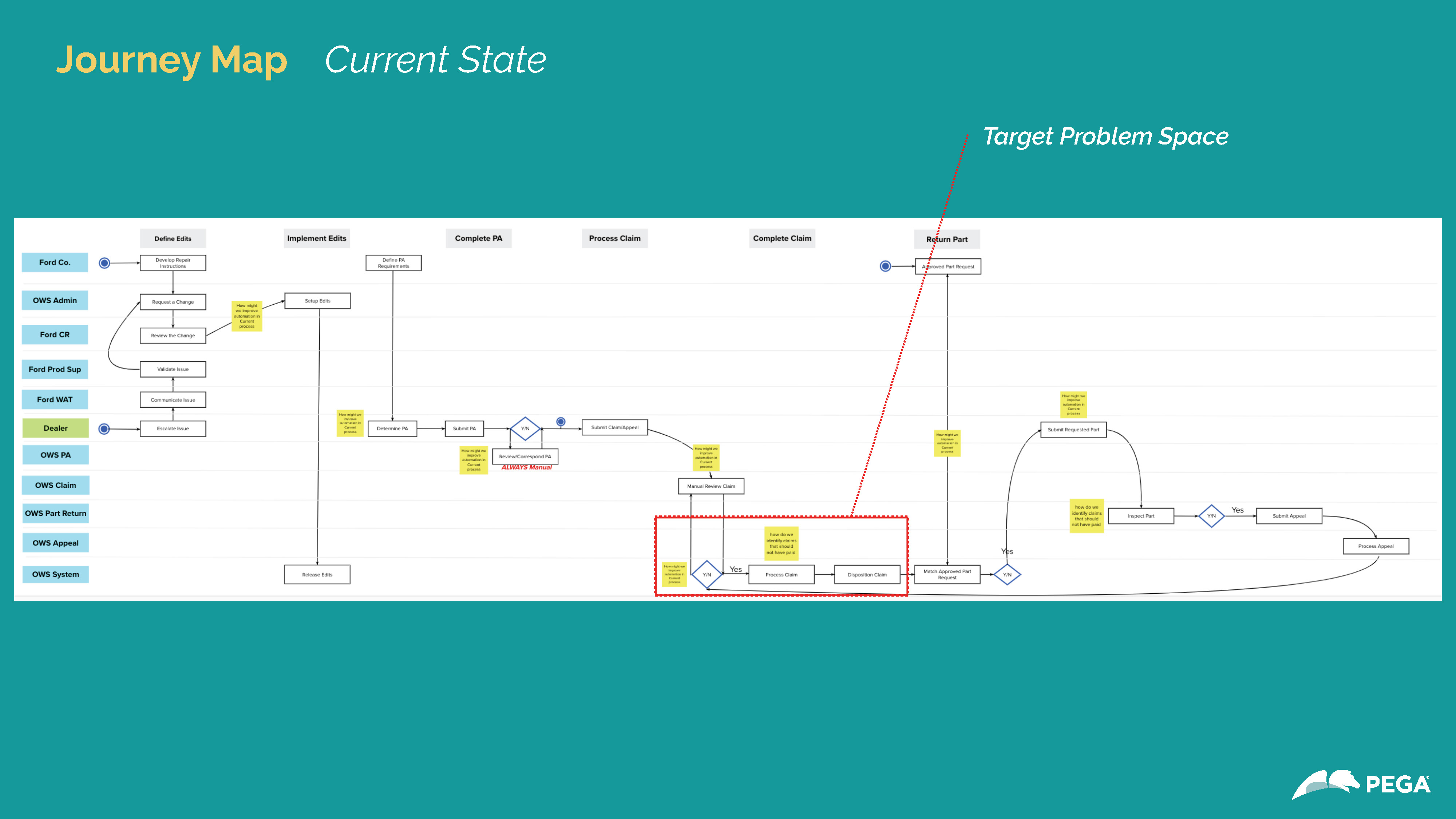
Ford's OWS processes were deeply layered, exception-driven, and highly manual. Overpayments often went unnoticed until after claims were processed, and existing tools made it difficult for internal teams to catch anomalies at scale. The challenge: how might we help Ford reduce unnecessary claim payouts and streamline internal workflows, without overhauling the platform from scratch?
Process & Solution
The sprint. Using the Pega Catalyst methodology, I facilitated a three-week design sprint with Ford stakeholders to co-create and validate a new experience. The first week focused on pre-workshop prep, reviewing current-state workflows, technical constraints, and exception processing logic through documentation and internal interviews. The second week brought the team together for a design thinking workshop built around journey mapping, pain-point analysis, and co-ideation, which surfaced the key opportunity areas. In the third week, we built a clickable prototype, tested it with internal OWS users, and synthesized that feedback into final recommendations for an executive readout.
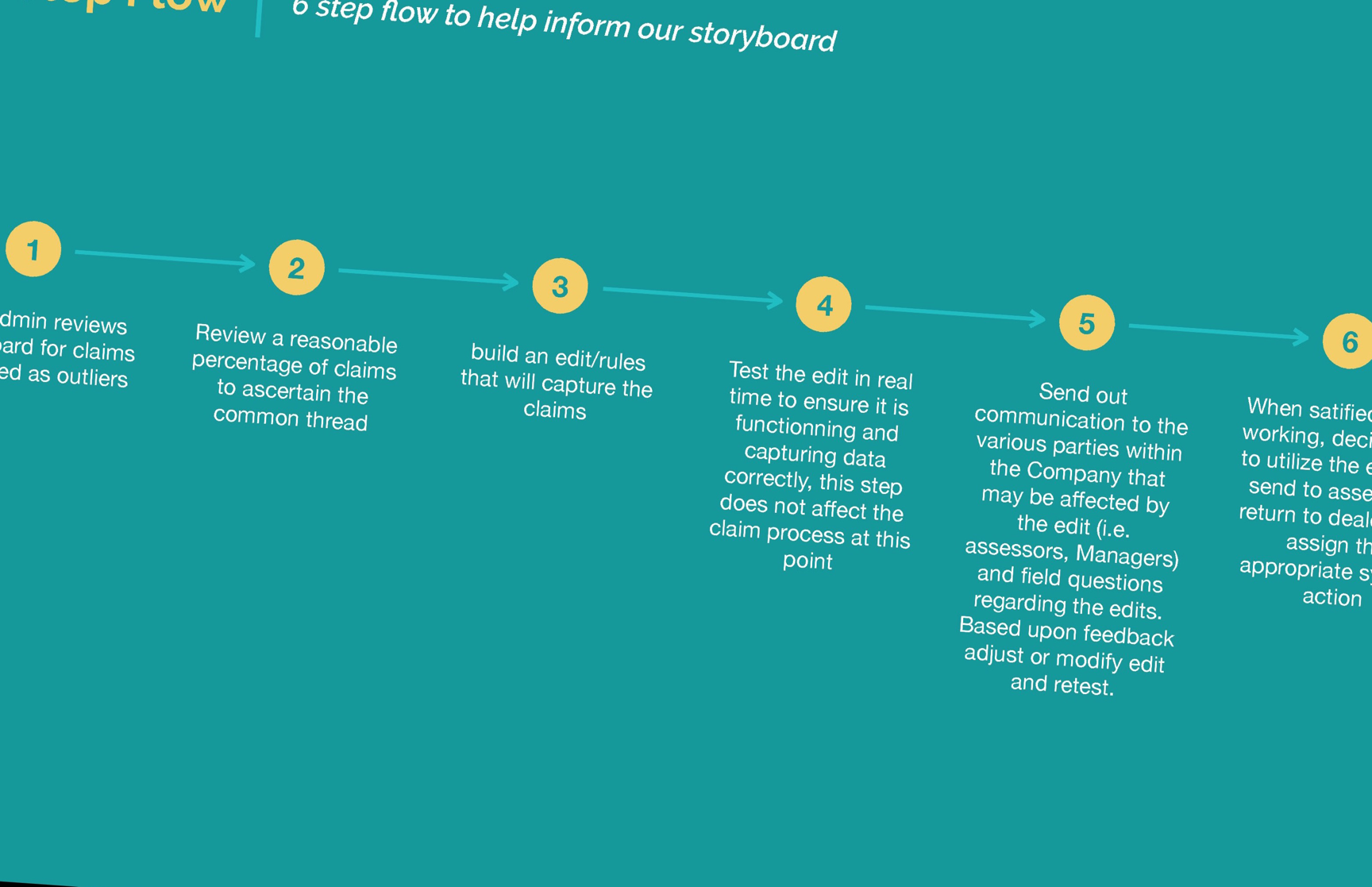
From tasks to insights. Early conversations centered on streamlining task workflows, but user research quickly revealed a deeper need: giving users context-rich, actionable insights that let them spot claim anomalies early and make data-informed decisions. That reframing shifted the design in three ways:
- From task execution to pattern detection
- From linear processing to visual drill-down
- From reactive cleanup to proactive risk mitigation
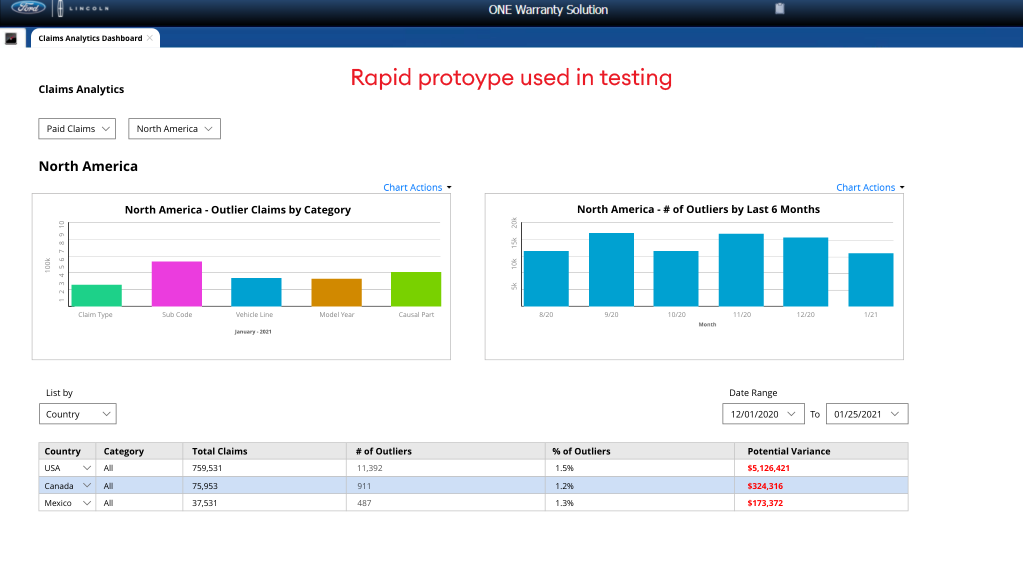
The dashboard. That shift led to the Claims Analytics Dashboard, a new experience giving warranty admins a clearer, more efficient way to detect and investigate outlier claims. Admins log into OWS, see which regions show overpayment anomalies, and drill into specific facilities and sub-codes to investigate further. From there, they can export flagged results to share with leadership and use those data-backed trends to refine internal validation rules over time, turning a reactive review process into one that catches systemic issues before they become costly.
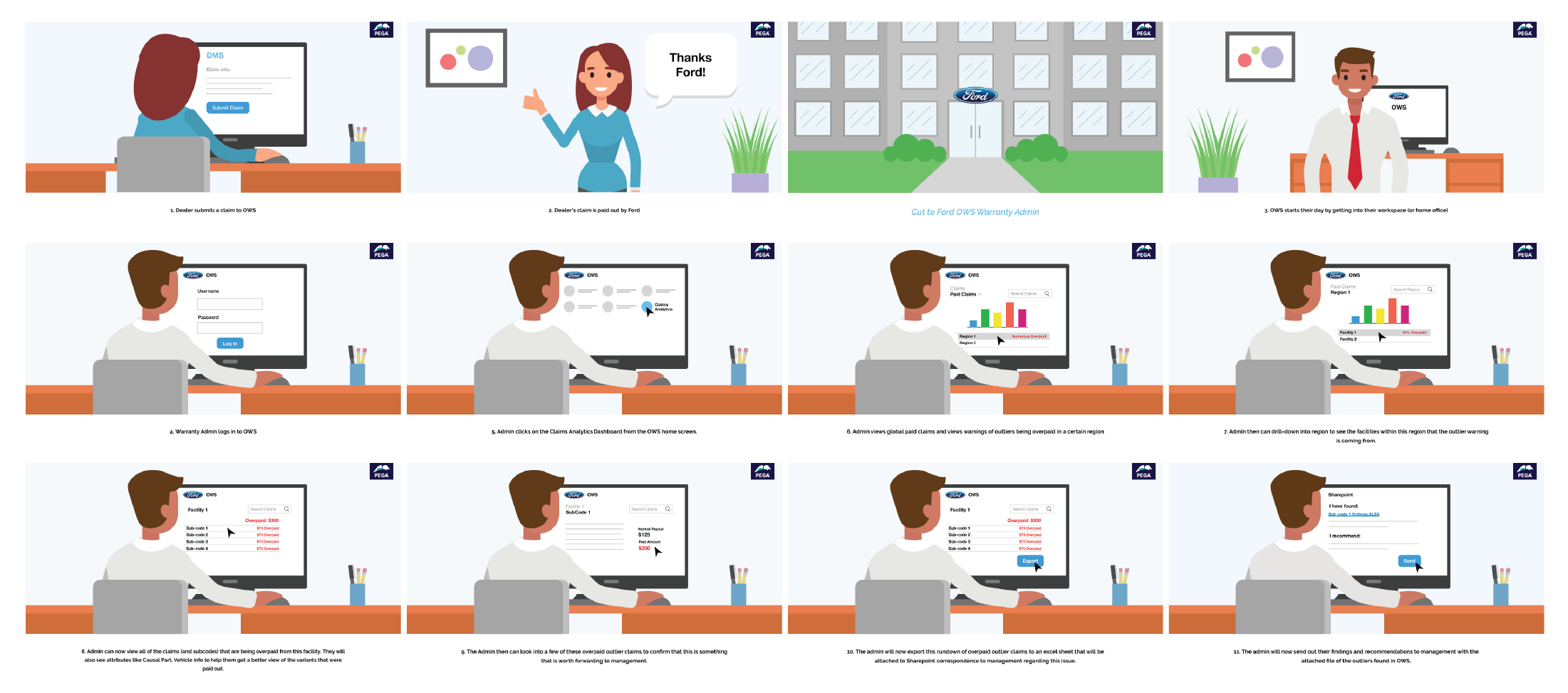
Validation. We ran informal testing sessions with Ford's internal OWS users to see how the concept held up in practice. The drill-down navigation felt natural, and users specifically called out the regional-to-facility-to-sub-code flow as intuitive, with export functionality that mapped cleanly onto their existing workflows. Testing also surfaced real gaps to address: the term "outlier" needed clearer definition, some users wanted more visibility into claim-level detail, and there was appetite for tighter SharePoint integration going forward.
Impact
- Early anomaly detection reduced unnecessary claim payouts
- Streamlined processes enabled more efficient internal reviews
- Insight-driven experience improved user confidence
- Executive alignment created clear next steps for follow-up exploration
Deliverables
- Current-state and future-state workflow diagrams illustrating the shift from manual review to anomaly detection
- Claims Analytics Dashboard prototype with drill-down navigation
- User testing synthesis from Ford's internal OWS users
- Journey maps and redesigned workflow documentation
- Executive readout and strategic recommendations
Visuals shown reflect sprint workshop prototypes and mockups using representative data. No real claims information or production screens are included.